Most small apartments aren’t actually short on space — they’re short on furniture and habits that work for the space they have. A couch that only seats people, a dresser that only holds clothes, a corner nobody’s touched since move-in day. Change those, and the apartment feels different without a single wall moving.
Here are 25 ways to do that. Some are furniture decisions, some are five-minute fixes, a few just mean rearranging what’s already there.
1. Buy Furniture That Does More Than One Job
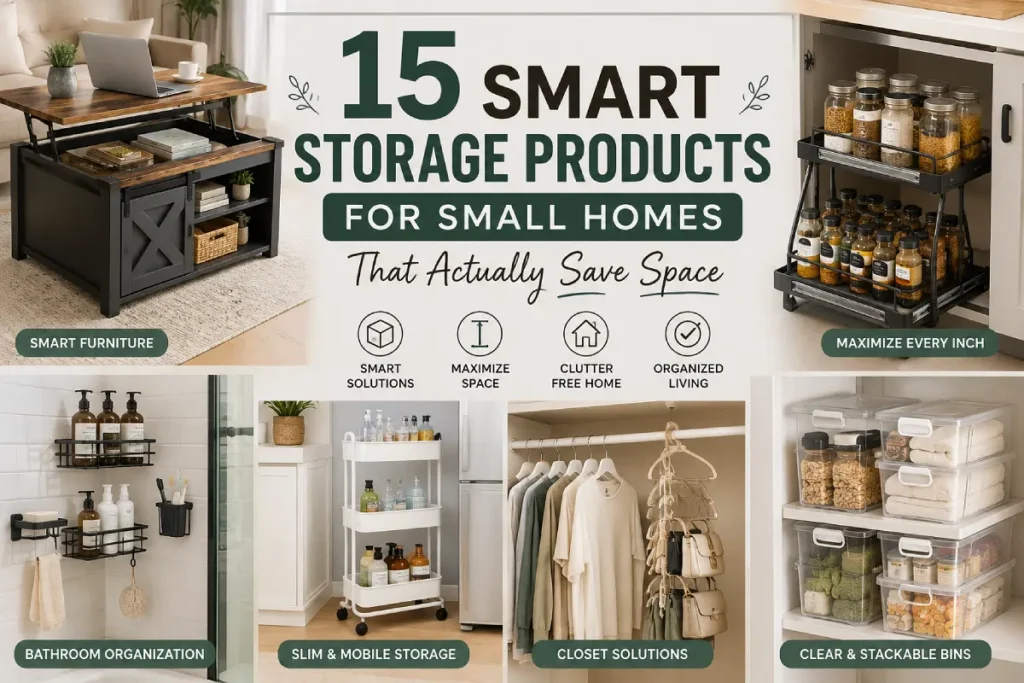
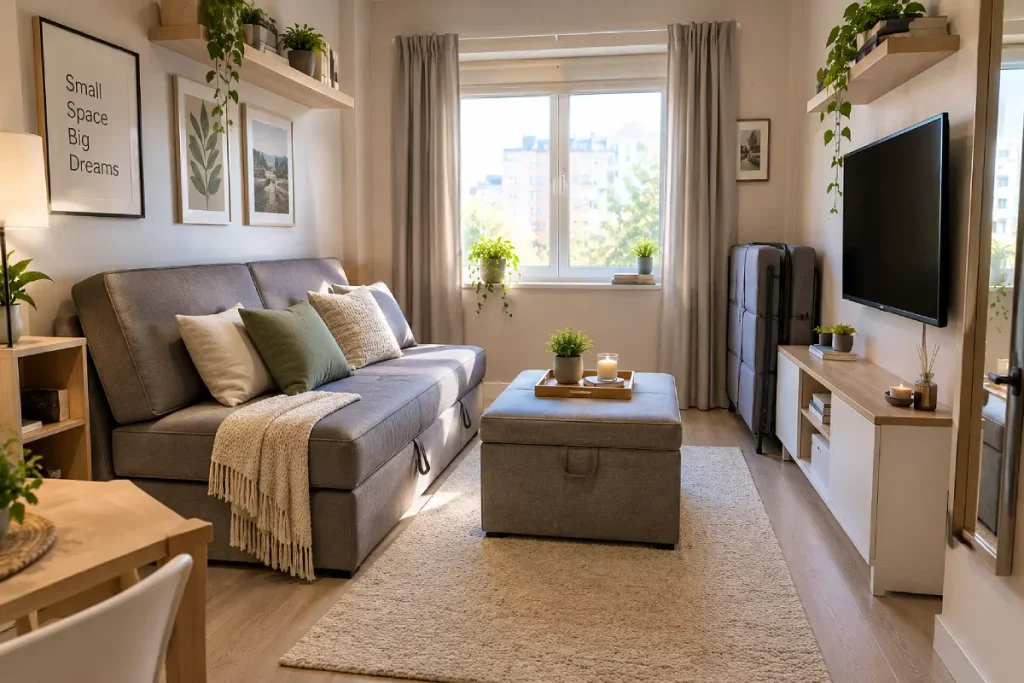
A sofa bed sleeps guests without a spare room. A storage ottoman holds blankets and doubles as a coffee table. A bench by the door gives you a place to sit and a place to stash shoes underneath. Each of these replaces two pieces of furniture with one, which is the whole point in a small space — fewer separate items, less floor claimed.
This applies to almost any purchase decision. A console table with drawers instead of an open shelf, a bed frame with storage built into the base — anywhere a single object can cover two needs, it’s worth the extra look before buying the single-purpose version.
2. Store Things That Fold Away When Not in Use
Some furniture only earns its space part-time. A folding dining table stays flat against the wall until people are over, then opens up for dinner. Stackable chairs sit in a closet corner instead of taking up floor space every day of the week.
The advantage is you get the function — extra seating, a full dining table — without paying for it in square footage year-round. A studio with a folding desk can be an office in the morning and an open room by afternoon.
3. Use the Space Under the Bed
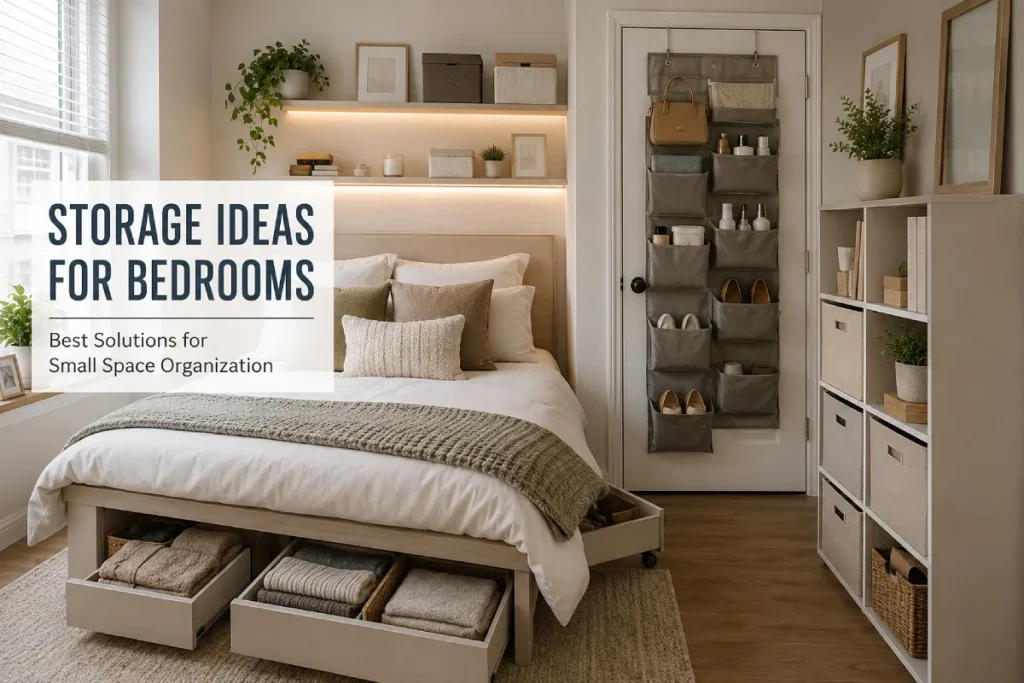
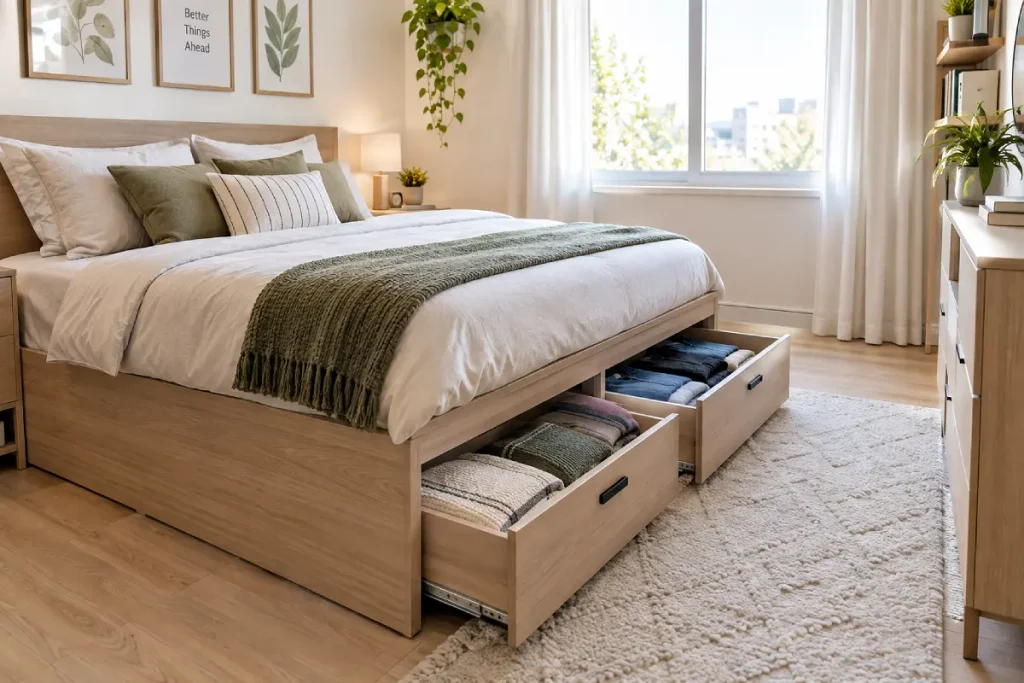
Most beds leave a foot or more of empty air underneath, and most people never use it. A bed frame with built-in drawers, or just a set of flat under-bed bins, turns that gap into storage for off-season clothes, extra bedding, or shoes that don’t fit in the closet.
It matters most in a studio, where the bed and the living space share a room and there’s no separate closet or storage room to absorb the overflow.
4. Go Taller Instead of Wider With Shelving
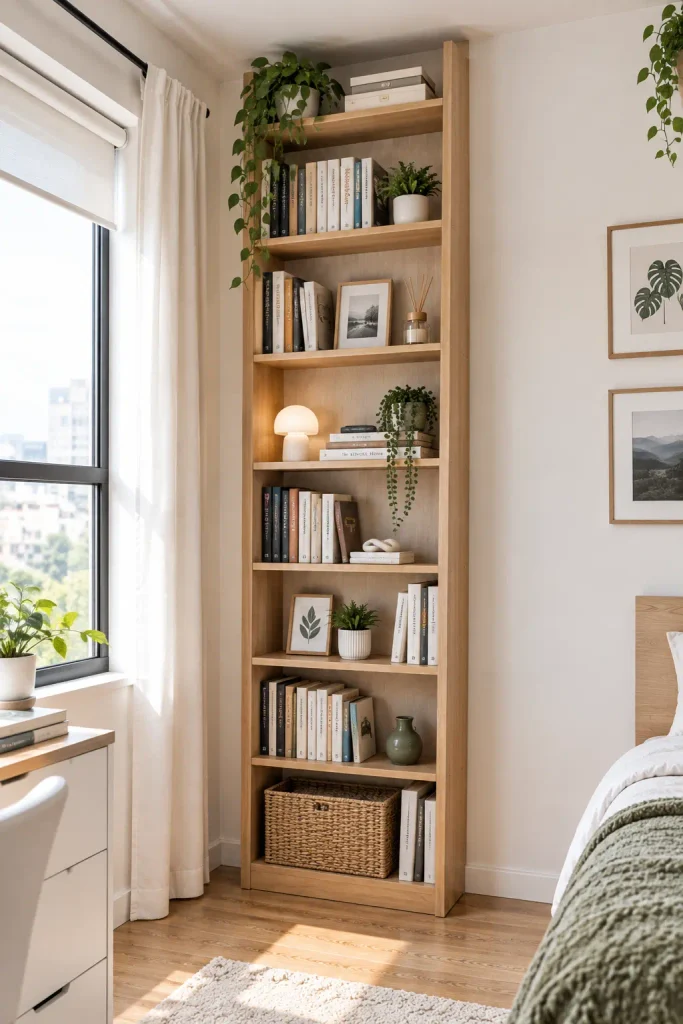
A tall, narrow bookshelf holds as much as a wide, waist-high one, and it leaves the floor around it clear. Wall height is almost always available in a small apartment even when floor space isn’t, so the swap is simple: next time a dresser or cabinet needs replacing, look for something taller rather than wider.
5. Mount Shelves Directly to the Wall
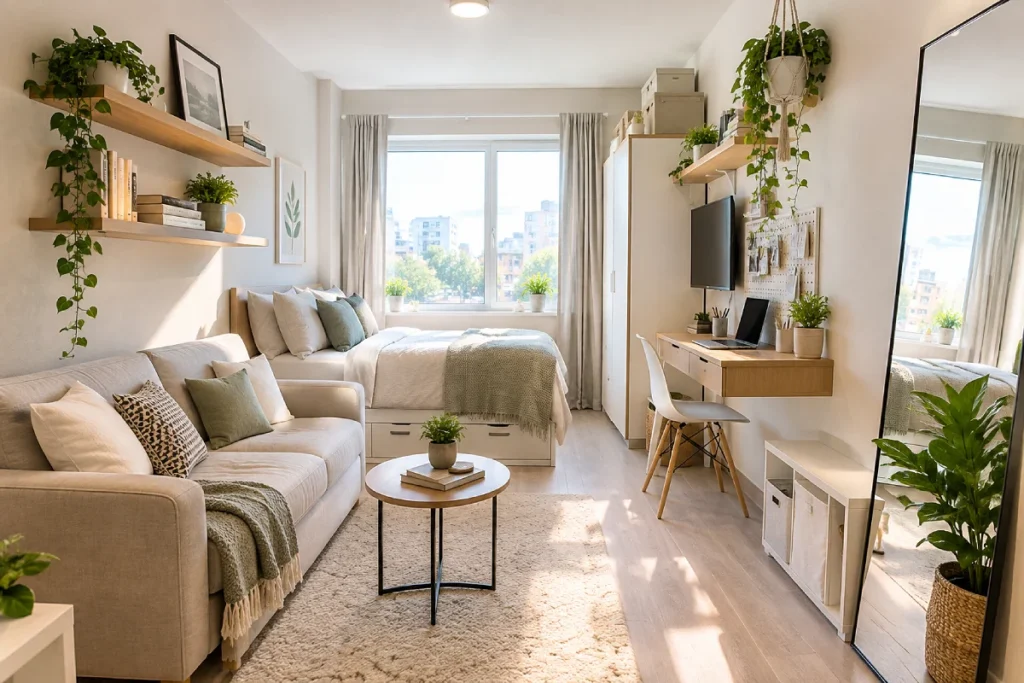
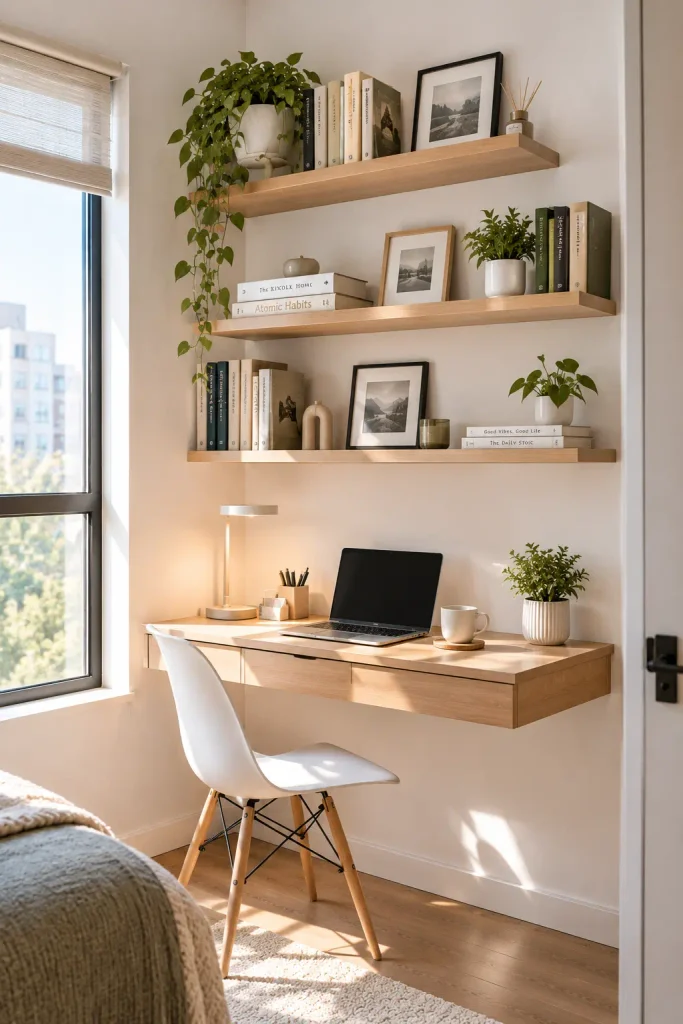
A blank wall is unused storage. Floating shelves fix that without taking up any floor space at all — no legs, no base, nothing standing on the ground. They work well for books, a few plants, framed photos, anything that would otherwise end up on a table or counter.
Three shelves staggered above a desk or headboard can hold roughly what a small bookcase would, and they read as decor rather than storage, which matters in a room that’s already visually busy.
6. Put a Large Mirror Somewhere It Reflects Light
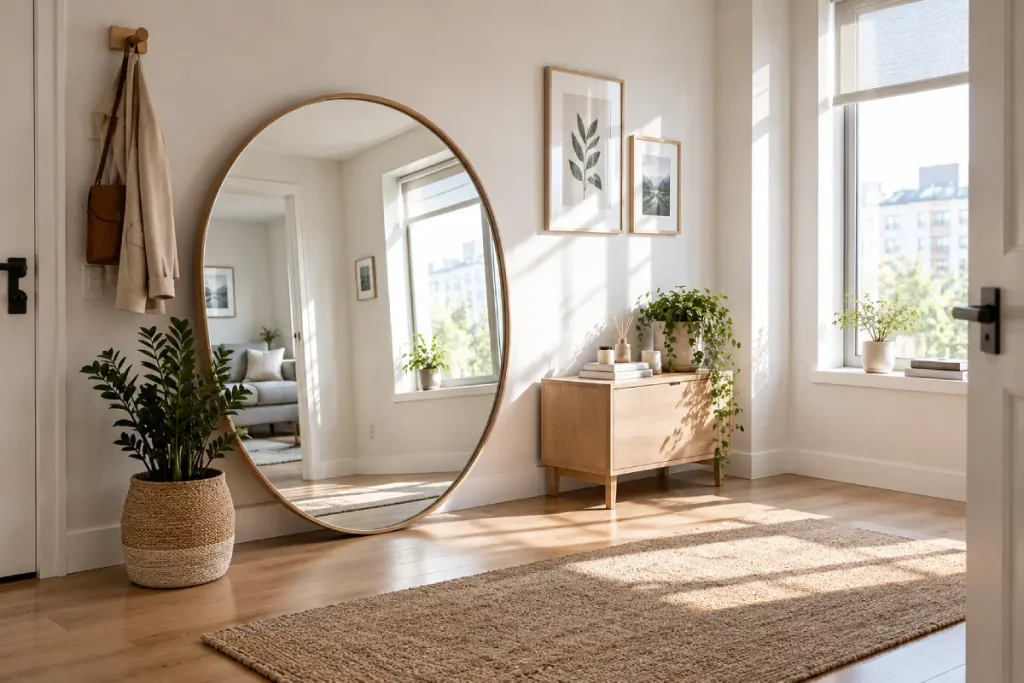
A mirror doesn’t add space, but it changes how the eye reads the room. Placed across from a window, it bounces daylight back into the space and doubles the sense of depth. A large mirror at the end of a hallway makes that hallway look longer than it is.
Placement decides whether this works. A mirror facing a blank wall does very little. One facing a window or an open sightline actually does something.
7. Paint and Decorate in Light, Neutral Tones
Dark walls absorb light and can make a room feel like it’s closing in. White, cream, and soft gray do the opposite — they reflect what light there is and make walls feel like they’re receding instead of pressing in.
This doesn’t mean the room has to look sterile. A neutral base with a couple of stronger accents — a rug, some pillows, one piece of art — keeps it from feeling flat while still getting the benefit of a lighter palette.
8. Choose Furniture With Raised, Visible Legs
A sofa that sits flush to the floor blocks the sightline underneath it, which reads as more solid mass in the room. The same sofa on slim legs lets the floor continue visually behind it, and that alone makes a room feel less crowded even though nothing has actually changed size.
Most furniture comes in both versions. The raised-leg option is usually the better call in a small room.
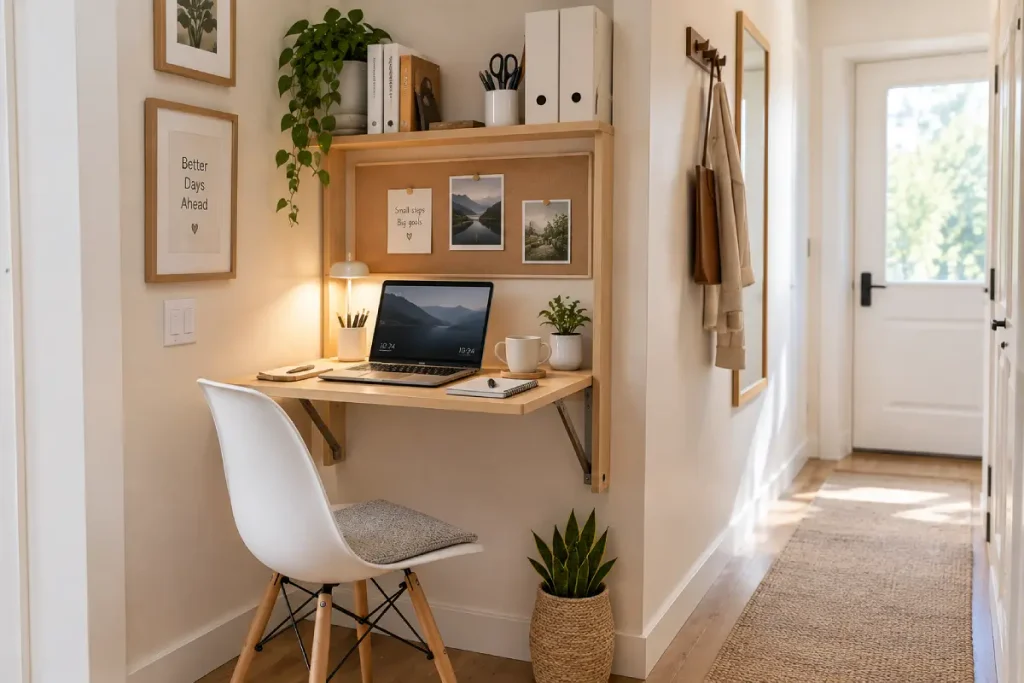
9. Set Up a Desk That Mounts to the Wall
A standard desk-and-chair setup takes up more floor space than most people plan for, and a chunk of it goes unused once the workday’s over. A wall-mounted desk — a fixed shelf or a fold-down panel — gives you a real work surface without that permanent floor footprint.
A hallway or a closet with a mounted desk and a shelf above it can become a workable home office corner without ever feeling like it’s competing with the rest of the room.
10. Turn Awkward Corners Into Something Useful
Every apartment has a corner that’s too narrow or too oddly shaped for regular furniture. Those corners are more usable than they look — a triangular shelf, a chair with a reading lamp, a slim desk that fits nowhere else.
Left alone, these spots tend to collect clutter by default. Given a specific purpose, even a small one, they stop being dead space.
11. Add Wall-Mounted Lighting Instead of Lamps
A table lamp needs a table. A floor lamp needs floor space. A wall-mounted sconce or a swing-arm reading light needs neither — it screws into the wall and does the same job without claiming a surface.
This helps most in a small bedroom, where the nightstand is often already doing double duty as storage and a place to set a glass of water. Move the light to the wall and the nightstand has room to breathe.
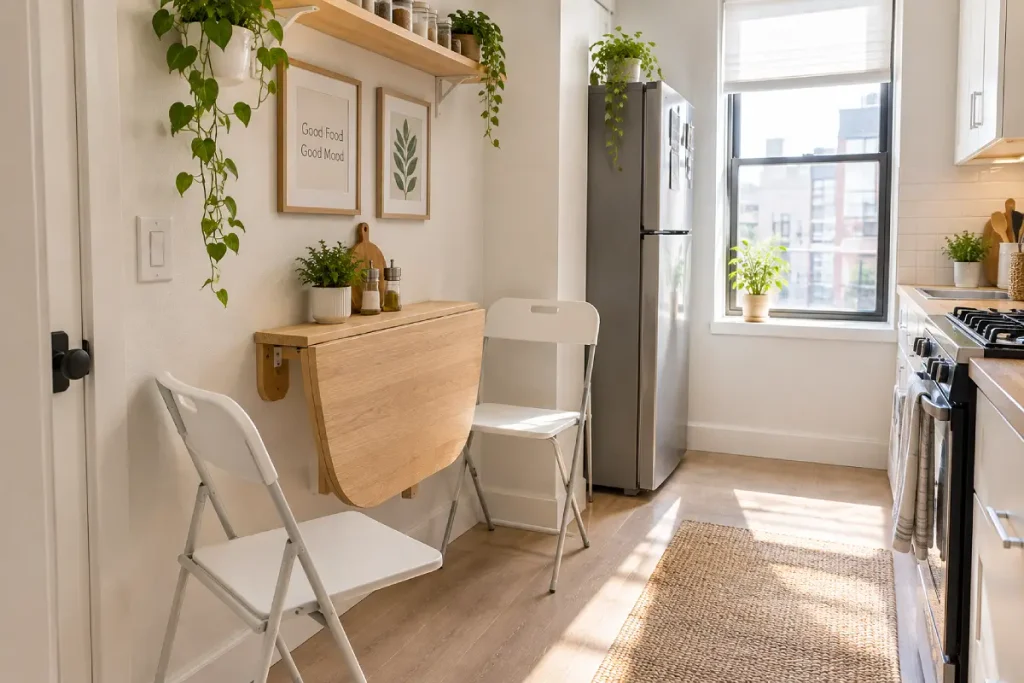
12. Get a Dining Table That Shrinks When You Don’t Need It
A table sized for six in an apartment built for two just sits there most days, blocking a path you’d otherwise walk through. A drop-leaf table solves that — full size for guests, folded down to a narrow strip against the wall the rest of the time.
Pair it with chairs that stack or slide under the table, and the whole dining setup can shrink to almost nothing between meals.
13. Get Things Off the Kitchen Counter and Onto the Wall
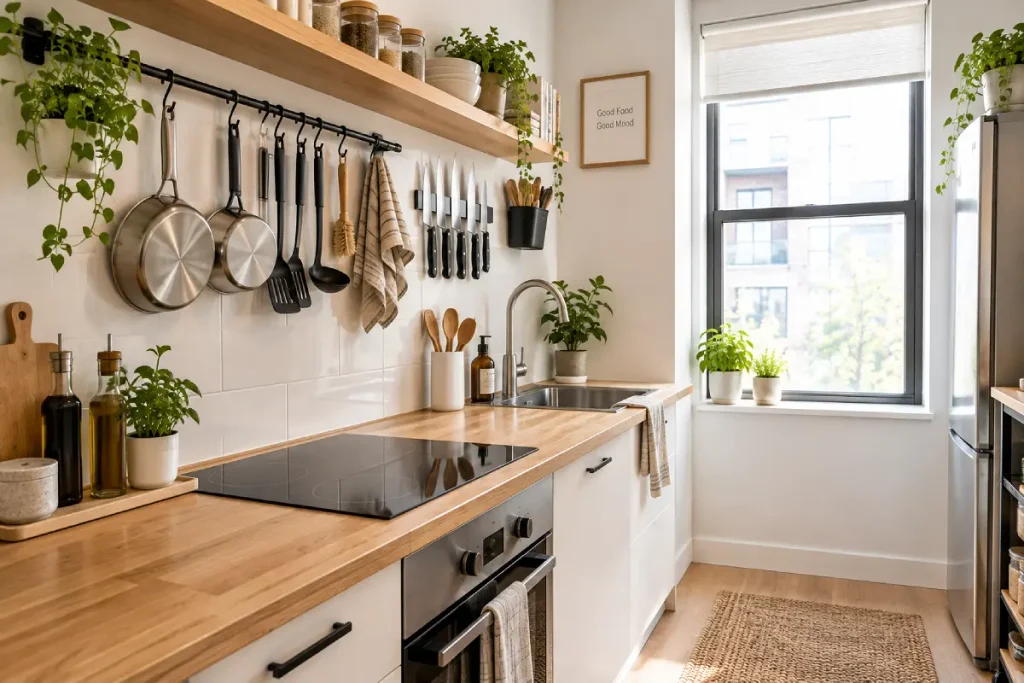
Countertops fill up fast — knife blocks, cutting boards, whatever appliance is used often enough to stay out. A rail with hooks, or a magnetic strip for knives and spice jars, moves half of that off the counter and onto a wall that was doing nothing.
It won’t make the kitchen bigger, but it clears the actual workspace, which is usually the thing that’s actually missing.
14. Use a Rolling Cart in a Gap Nothing Else Fits
Most apartments have at least one space too narrow for real furniture — beside the fridge, next to a dresser, at the end of a short hallway. A slim rolling cart fits spaces like that and can work as extra kitchen storage, a small bar cart, or a bathroom caddy.
Because it’s on wheels, it can move between rooms as needed, which is more flexibility than fixed furniture offers.
15. Give the Entryway an Actual Job
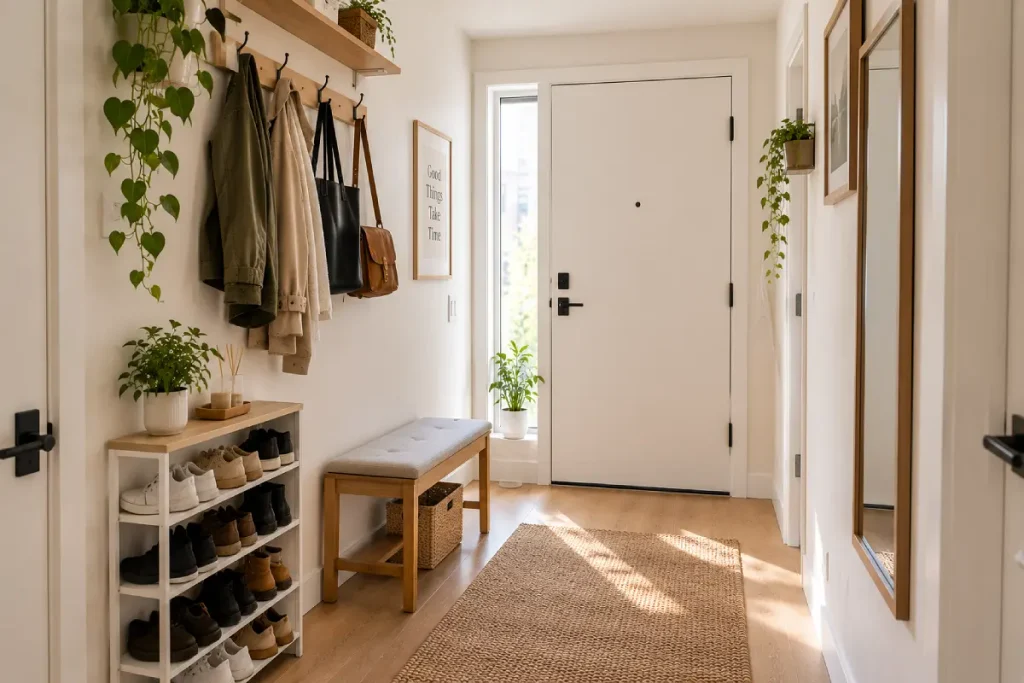
Without a defined spot for keys, shoes, and bags, they end up on whatever surface is closest to the door — usually the dining table. A couple of wall hooks, a slim shoe rack, and a small bench solve most of that in a few square feet.
The entryway doesn’t need to be a room. It just needs somewhere for the stuff that would otherwise spread across the apartment.
16. Use Rugs to Separate Zones in an Open Layout
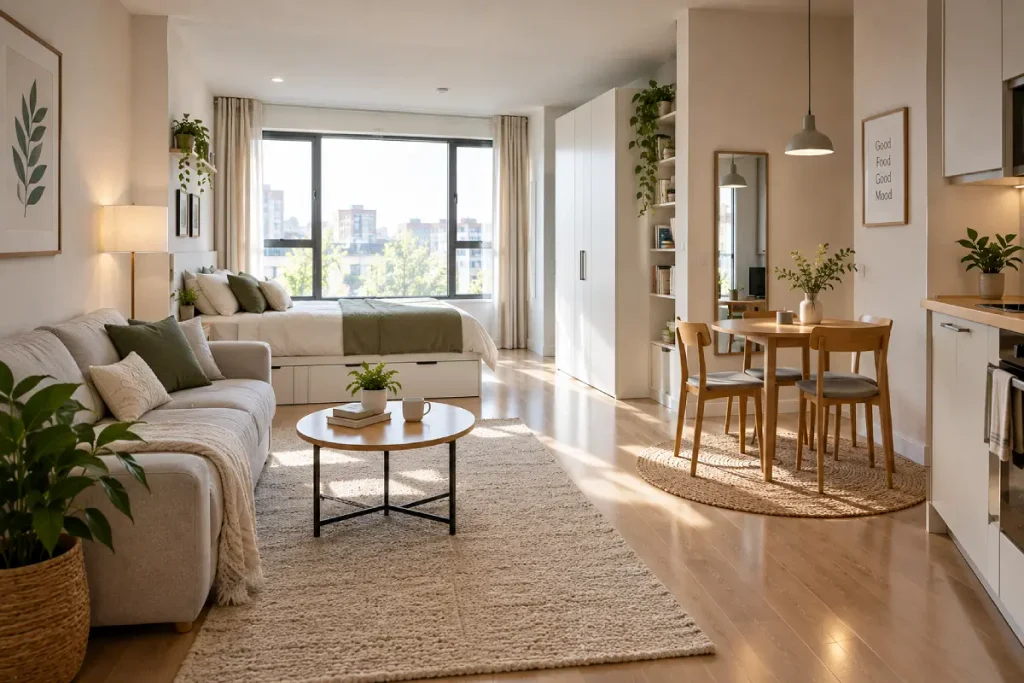
In a studio or open-plan apartment, the living room, dining spot, and workspace can blur into one undefined area. A rug under the sofa marks off the living zone; a smaller one under the dining table marks that off too, without a single wall added.
A room with clearly defined areas feels more organized, even when it’s technically one open space.
17. Replace Solid Doors With Sliding Ones Where You Can
A swinging door needs a clear arc of floor space to open, which is often more than people budget for in a tight room. A sliding or barn-style door removes that requirement, since it travels along the wall instead of into the room.
It’s a bigger project than most ideas on this list, but worth it for a closet, bathroom, or bedroom where a swinging door is costing you space you could actually use.
18. Bring in Plants Without Using Floor Space
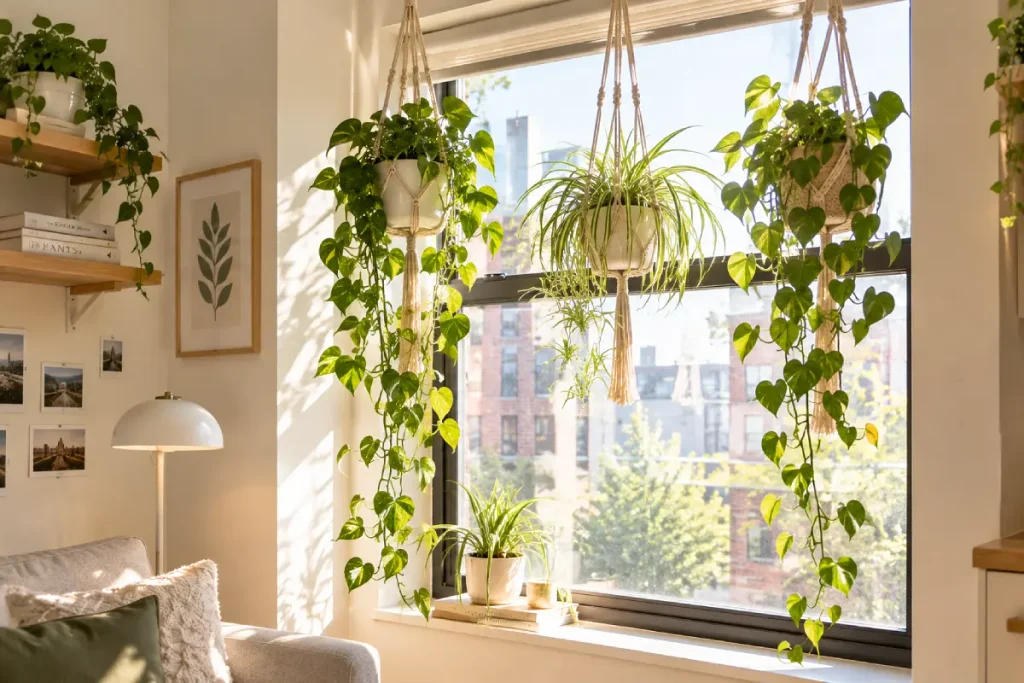
A row of floor plants looks good but eats into walking room fast. Hanging planters near a window solve that — a few pothos or spider plants in macramé hangers add greenery without costing any floor space at all, and they draw the eye up, which does something for the sense of height in the room too.
19. Match Furniture Size to the Room, Not the Showroom
A deep sectional might look right in a furniture store, but in a small living room it can end up swallowing the entire space, leaving nothing for anything else. Furniture scaled to the actual room leaves room to walk, and the room reads as larger for it.
Before buying anything large, measure the walking space around it, not just where it’ll sit. Less than two feet of clearance usually means it’s too big for the room.
20. Use Furniture Placement to Create Separate Zones in One Room
In a studio, where the couch faces matters as much as what it’s facing. A bookshelf angled to separate a sleeping area from a living area, or a desk pushed into a corner to create a distinct work spot, gives each part of the room its own identity without adding a wall.
21. Get Rid of What You’re Not Using
Every storage idea on this list matters less if the apartment is full of things that don’t need to be there. A closet of clothes that don’t fit, a shelf of books already read — that’s square footage spent on stuff instead of living space.
A regular pass, every season or whenever storage starts feeling tight again, keeps the apartment from slowly filling back up. Bins and labels help with organizing what’s left, but the actual fix is being honest about what’s getting used and what isn’t.
Final Thoughts
A small apartment stops feeling small once the furniture starts working for the space instead of against it — once the walls are holding something, the floor is visible, and every item in the room has a reason to be there.
Pick two or three ideas from this list to start: a bed with storage underneath, a mirror across from the window, one corner that finally gets used. The rest can wait until there’s time.
This post contains affiliate links, and I may earn a small commission at no extra cost to you if you purchase through them. Images in this post are AI-generated for illustrative purposes.